Lucas' Hut
/What .boxed() actually costs you (and a tiny crate to avoid it)
TLDR
.boxed() from the futures crate reads beautifully at the end of an async block, but it's not free: it performs type erasure and hands you a BoxFuture, which means every poll goes through dynamic dispatch.
I got curious enough to actually measure it. The runtime overhead of dynamic dispatch is real, but I wondered how real, depending on the context, use case, etc.
So I shipped a tiny crate called boxpin that gives you the suffix ergonomics of .boxed() while doing exactly what Box::pin(...) does and nothing more:
use boxpin::BoxPinExt;

let future = async { 42 }.pinned();
No type erasure or dynamic dispatch. Same type, same cost as Box::pin(future), and full inlineability.
Why I started poking at this
Box::pin(...) is what you actually want, most of the time. You have an async fn or an async block, the compiler tells you the future isn't Unpin, you box-pin it and move on.
But syntactically Box::pin(...) is a prefix. It wraps the whole expression. If you're chaining async builders or returning a future from inside a match arm, you have to backtrack and add an opening paren way up top. It's annoying. And IMO super unreadable.
.boxed() is a suffix. It reads top-to-bottom. You write the future, then say .boxed() and you're done. Beautiful.
The catch: .boxed() does more than Box::pin. It also performs type erasure. The return type is BoxFuture<'static, T>, which expands to Pin<Box<dyn Future<Output = T> + Send + 'static>>. That dyn is the part that costs you. Every poll is a vtable lookup, and the compiler can no longer inline through the boundary.
Quick refresher on type erasure. When the compiler sees a concrete future type, it can inline the body, fold combinators, and reason about the call as if it were ordinary synchronous code. As soon as you hide that type behind
dyn Future, all of that goes away. The future becomes a black box behind a function pointer.
The question I wanted answered: how much does that nicer-looking call actually cost?
What the benchmark actually does
The full harness lives at github.com/ae2rs/boxpin. It's Criterion, with seven scenarios (immediate_ready, pending_8, pending_64, large_capture_4k, combinator_chain_16, plus two layered families) measured at five life-stages: construct, first_poll, complete_manual, block_on, and inside both flavours of the Tokio runtime.
Every scenario compares the same future under three strategies:
// 1. no_box: the raw future, baseline
let f = make_future();

// 2. concrete_pin: Box::pin, no type erasure
let f = Box::pin(make_future());

// 3. boxed_method: futures::FutureExt::boxed, with type erasure
let f = make_future().boxed();
concrete_pin is what .pinned() does in the boxpin crate. boxed_method is the .boxed() from the futures crate.
I'm not benchmarking allocation cost here. Every strategy that boxes pays for one Box::new, so that part cancels out. The interesting cost is what happens after the future is built: the polls.
Setup. All numbers below come from
cargo bench(release mode, with Criterion's defaults: 30 samples, 500ms warmup, 1s measurement). Lower is better.
Headline chart: the basic scenarios
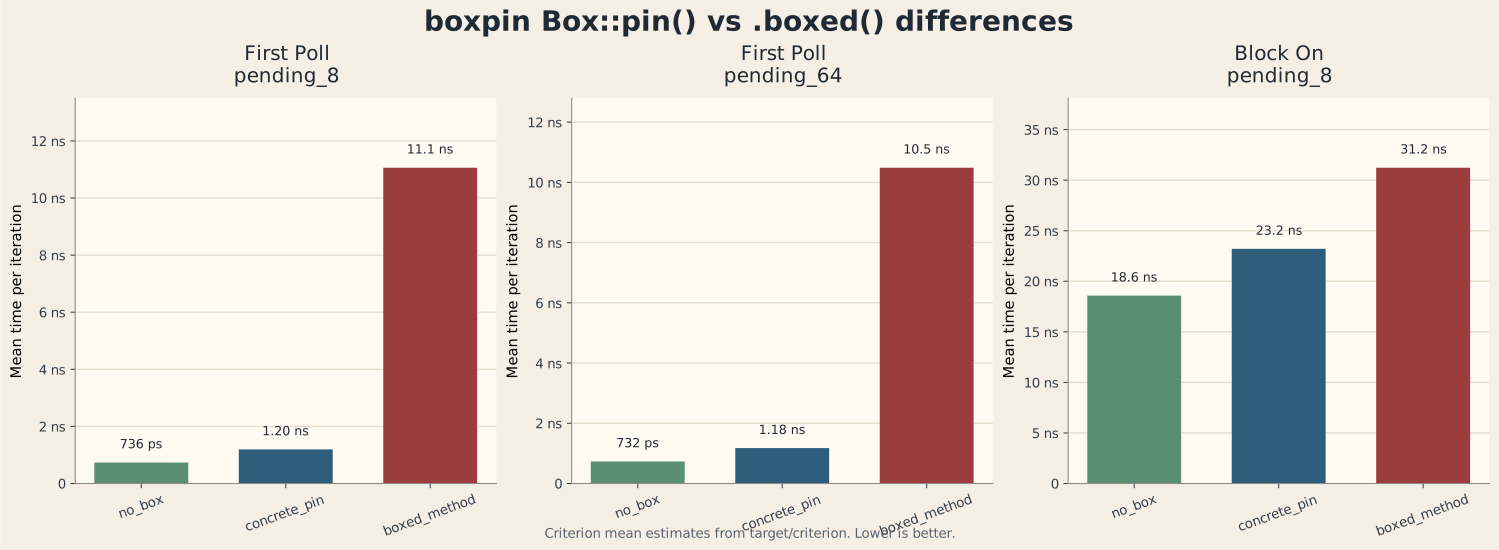
A few things jump out.
On first_poll, the picture is clean. For pending_8, the raw future takes about 736 ps, concrete_pin is 1.20 ns, and boxed_method jumps to 11.1 ns. That's a roughly 9x slowdown versus the un-erased pin. pending_64 looks almost identical: 732 ps / 1.18 ns / 10.5 ns. The first-poll cost barely depends on how much work the future will eventually do, because we're only paying for the dispatch into the future, not for the future's body. The erased version pays for a vtable call; the concrete one inlines.
Once you switch to block_on, the runtime starts to dominate. For pending_8, the three numbers are 18.6 ns, 23.2 ns, and 31.2 ns. The gap between concrete_pin and boxed_method shrinks to about 1.3x, because most of the time is now spent waking and re-polling, not in the dispatch itself.
This is what I expected: erasure cost is per-poll, and it shows up most clearly when per-poll work is small.
Where it really hurts: layered/middleware stacks
The flat numbers are interesting but easy to brush off. The picture gets a lot more dramatic when you stack futures inside futures.
The layered scenarios put eight ForwardLayer<F> wrappers around a base future. Think of it as a stand-in for tower-style middleware composition, where each layer wraps and forwards to the next. With concrete types, every layer compiles down to a flat call chain. With type erasure at each layer, every layer adds a dyn Future boundary, and every poll walks through eight vtable lookups before reaching the leaf.
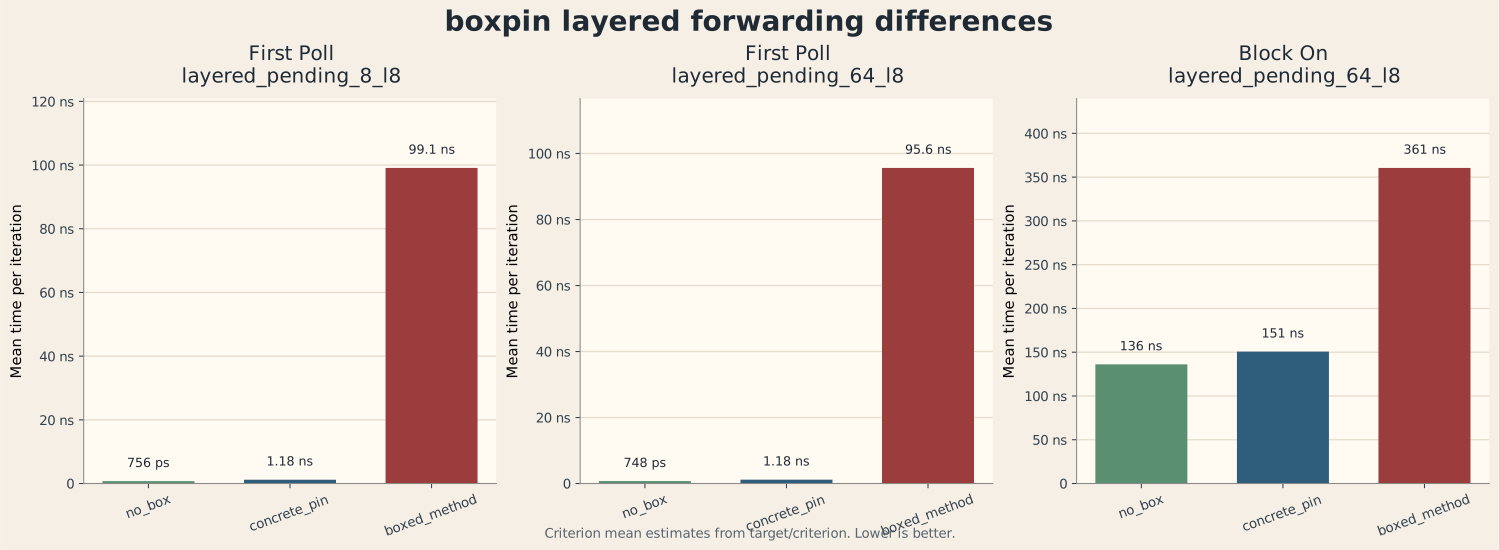
The first-poll numbers for layered_pending_8_l8 are 756 ps (no box), 1.18 ns (concrete pin), and 99.1 ns (boxed). That's an 84x gap between the two boxed strategies. Same shape for layered_pending_64_l8: concrete pin is 1.18 ns, boxed is 95.6 ns, roughly 81x.
The headline numbers are first-poll, but block_on on the same eight-layer stack still shows it: 136 ns concrete versus 361 ns boxed. That's a ~2.4x penalty that no amount of "amortised over a real workload" hand-waving makes go away. If you have an async pipeline with eight middleware layers and every leaf is .boxed(), you're paying that cost on every single request.
The mechanism is straightforward: vtable lookups stack additively, the optimiser can't see through the erased boundary, and once the compiler can't see through it, it can't inline, can't reorder, can't fold the layers together. Eight layers of erasure means eight times nothing-the-compiler-can-do.
Rule of thumb. A single
.boxed()at the edge of your app (where a runtime hands the future off to its executor anyway) is probably fine. A.boxed()inside every layer of a middleware stack is the case to actually worry about. The cost is per-poll and per-layer, so it multiplies fast.
The crate: boxpin
The fix is almost embarrassingly small. The whole crate is one trait and one method:
pub trait BoxPinExt: Sized {
    fn pinned(self) -> Pin<Box<Self>>;
}

impl<T: Sized> BoxPinExt for T {
    fn pinned(self) -> Pin<Box<Self>> {
        Box::pin(self)
    }
}
A blanket impl over every Sized type. Method named .pinned() because that's what you actually get back: a Pin<Box<T>> where T is the concrete, un-erased type.
In use:
use boxpin::BoxPinExt;

let value = async { 41_u8 }.pinned().await;
assert_eq!(value, 41);
x.pinned() is exactly Box::pin(x). Same allocation, same return type, same runtime cost. None of the per-poll overhead you saw above. The only thing it adds is the suffix syntax.
It's on crates.io as boxpin, docs at docs.rs/boxpin, source at github.com/ae2rs/boxpin. No deps. MIT or Apache-2.0, take your pick.
What about compile times?
The benchmark above measures one axis: runtime. There's another axis I haven't measured, and which I think might actually go the other way.
.boxed() collapses monomorphisation at its boundary. The body of the erased future is compiled once, not once per concrete instantiation. In a very large async codebase (one with deeply nested async fns where each one expands into a unique anonymous future type), that collapsing might significantly reduce what the compiler has to chew through. So the same dynamic dispatch that hurts at run time could be helping at build time.
I haven't measured it. It's the kind of thing you'd want to test on a real codebase, not a microbenchmark. Pick a large async project, swap Box::pin for .boxed() at the boundaries that matter, and time cargo build cold and incremental.
If you try this, I'd love to see the numbers. Drop them in an issue on the boxpin repo and I'll happily fold them into a follow-up.
Maybe that's the next post. For now: if you care about runtime, .pinned() is a free win over .boxed(). If you care about compile time, the answer is genuinely unclear, and I'd love to see it benchmarked.